EVA Sole vs Rubber Sole vs TPR: Which Sole Should You Actually Choose?
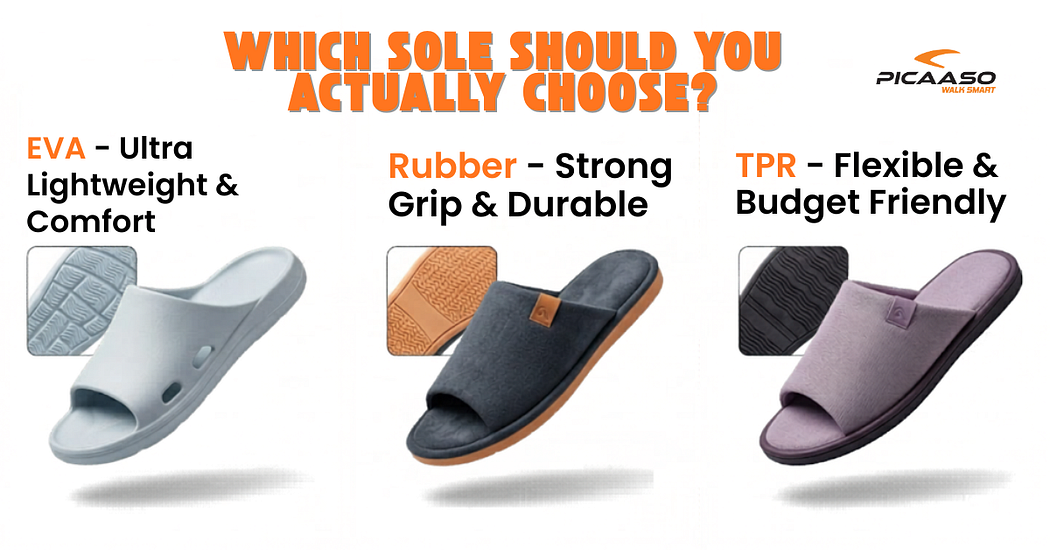
This blog explains one of the most important but often ignored parts of footwear — the sole material. While most people focus on design and looks, the sole actually determines comfort, durability, grip, and overall foot health. Choosing the wrong sole can lead to discomfort, faster wear and tear, and wasted money.
The guide compares six major sole materials — EVA, Rubber, TPR, TPU, PU, and Phylon — in simple language, helping buyers make informed decisions based on their daily use, environment, and budget.
Overview of Sole Types
There are six commonly used sole materials in footwear, each designed for different purposes:
- EVA (Ethylene Vinyl Acetate): Lightweight, soft, and highly cushioned
- Rubber: Strong, durable, and provides excellent grip
- TPR (Thermoplastic Rubber): Flexible and budget-friendly
- TPU (Thermoplastic Polyurethane): Rigid and performance-oriented
- PU (Polyurethane): Long-lasting and maintains structure
- Phylon: A compressed version of EVA, slightly firmer and more responsive
Each material balances comfort, cost, and performance differently, making it important to match the sole with your lifestyle.
EVA vs Rubber: The Most Common Comparison
The blog highlights the key differences between EVA and rubber soles:
- Weight: EVA is significantly lighter, reducing strain during long hours of wear, while rubber is heavier but more robust.
- Comfort: EVA provides superior cushioning and shock absorption, making it ideal for daily wear. Rubber offers moderate comfort.
- Grip: Rubber performs best on wet, rough, or uneven surfaces. EVA is suitable only for dry and smooth surfaces.
- Durability: Rubber lasts longer and resists wear better, while EVA can compress over time.
- Price: EVA is more affordable, while rubber increases product cost.
For Indian conditions, EVA is better for daily use and summer, while rubber is ideal for monsoon and outdoor activities.
EVA vs TPR vs TPU
These three materials are often confused but serve different purposes:
- EVA: Best for comfort and lightweight footwear
- TPR: Slightly heavier but more flexible and cost-effective, commonly used in casual and school shoes
- TPU: Strong and rigid, designed for performance footwear like hiking and sports shoes
In terms of pricing:
EVA (Affordable) → TPR (mid-range) → TPU (premium)
EVA vs PU: Comfort vs Longevity
This comparison focuses on a key trade-off:
- EVA: Offers instant comfort, softness, and lightweight feel
- PU: More durable, retains shape longer, and suitable for long-term use
EVA is ideal for casual and everyday footwear, while PU is better for formal shoes and long-term durability.
EVA vs Phylon
Phylon is essentially an upgraded version of EVA:
- Made using compressed EVA
- Slightly firmer and more responsive
- Better shape retention under repeated use
However, for regular users, the difference is minimal. Phylon becomes relevant mainly for athletes and runners.
Best Sole for Running
The blog emphasizes that no single material is enough for running shoes:
- EVA: Used in the midsole for cushioning and shock absorption
- Rubber: Used in the outsole for grip and durability
The combination of EVA + Rubber is considered the industry standard because it balances comfort and performance effectively.
Comparison Insights (Key Takeaways)
- EVA: Best for comfort, lightweight feel, and affordability
- Rubber: Best for grip, durability, and outdoor use
- TPR: Ideal for budget casual footwear
- TPU: Suitable for performance and high-impact activities
- PU: Best for long-lasting formal footwear
- Phylon: Slight upgrade over EVA for sports performance
How to Choose the Right Sole
The blog provides a practical decision guide:
- Daily home/office use → EVA
- Outdoor/trekking → Rubber
- Budget casual footwear → TPR
- Running/gym → EVA midsole + Rubber outsole
- Formal daily wear → PU
- Hiking/performance → TPU
The key idea is simple:
Indian Market & Climate Perspective
The blog strongly focuses on Indian conditions:
- EVA performs well in heat and humidity
- Rubber is essential for monsoon and rough roads
- Lightweight footwear is preferred due to long daily wear hours
Brands like Picaaso prioritize EVA because it suits Indian consumers’ comfort needs and budget expectations.
Final Conclusion
There is no universal “best” sole material. Each one serves a specific purpose:
- Choose EVA for everyday comfort
- Choose Rubber or PU for durability and heavy use
- Choose TPR for budget-friendly options
- Choose TPU or Phylon for performance needs
The most practical solution for most users is a combination sole (EVA + Rubber), which delivers both cushioning and grip.
Read More: "https://picaasofootwear.com/eva-sole-vs-rubber-sole/"

%20(19).webp)

Comments
Post a Comment